The idea is appealing: rather than hiring a programmer, you demonstrate once and the robot learns. This is a fast-moving research area, and also one where the gap between demonstration video and usable product remains substantial.
Three ways to demonstrate
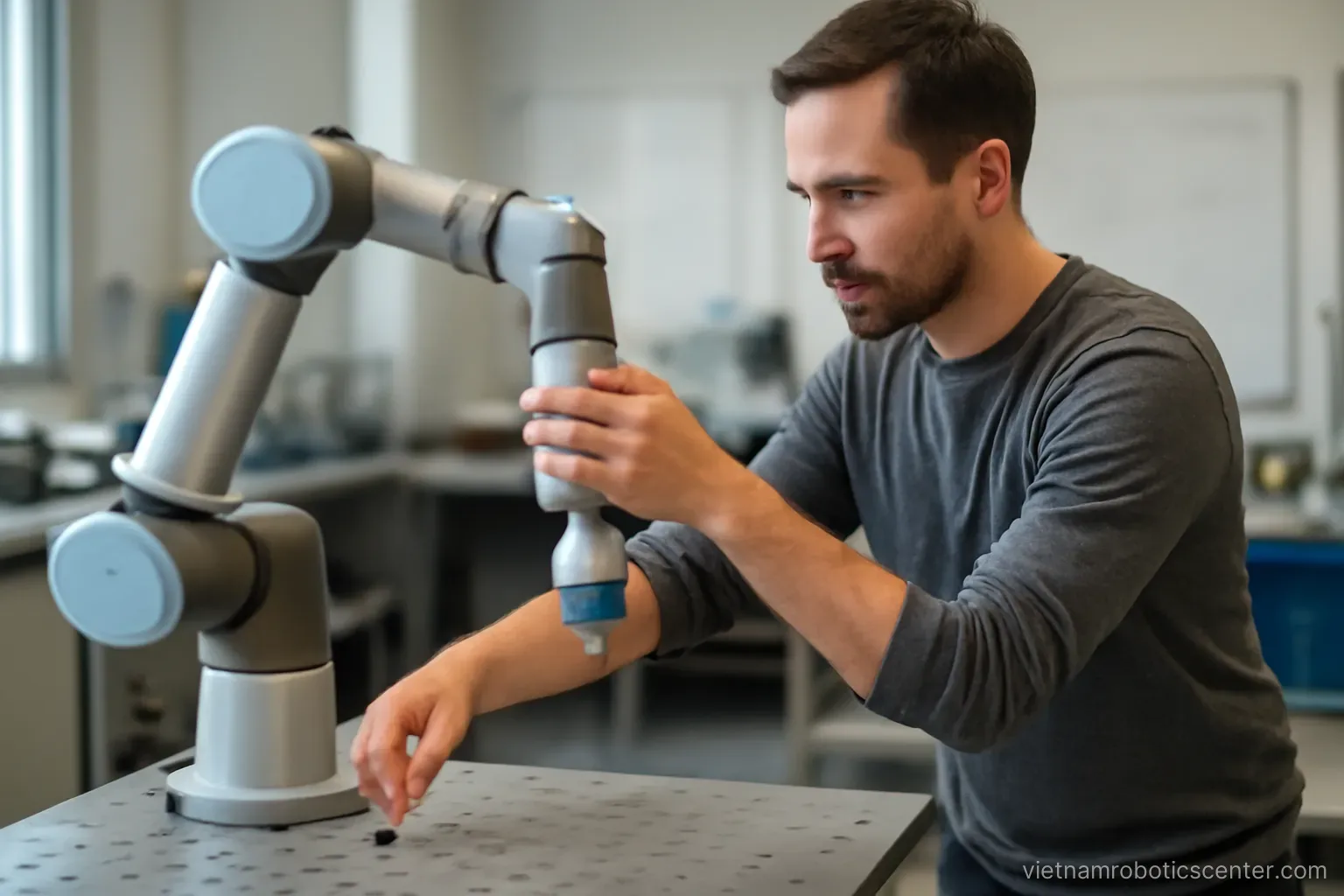
Hand guiding. A person physically moves the robot arm along the desired path while it records. Mature and available in commercial products, particularly collaborative arms.
Advantages: fast, intuitive, usable by a skilled worker without programming knowledge. Limitations: it records a path, not a strategy for handling variation.
Teleoperation. A person uses a controller to perform the task through the robot while the system records both actions and sensor data. This is the main method for gathering training data today.
Advantages: high-quality data capturing forces and context. Limitations: extremely labour-intensive, requiring many repetitions per task.
Video of people working. The robot learns from footage of humans performing the task. The most abundant data source.
Advantages: plentiful data. Limitations: video records no forces, and human bodies differ from robot bodies, making transfer difficult.
Where this actually stands
Three levels worth distinguishing when reading news in this field.
Deployed in products. Hand guiding to teach a fixed path, which the robot then repeats precisely. Common in industry and genuinely useful there.
In real-world trials. A robot learning a skill from a few dozen demonstrations and performing it with small variation — objects slightly displaced, shapes slightly different.
Still in the laboratory. A robot watching once and performing, learning one task and generalising to a similar one, understanding a spoken instruction and executing something never taught.
The videos that circulate widely usually belong to the third group, and the distance from there to a product is typically measured in years rather than months.
How to read a claim in this area: ask how many consecutive successful attempts, with how many different objects, in how many different settings. Those three numbers are usually absent, and their absence is itself informative.
What businesses can use today
Setting research aside, these are the usable forms.
Teaching a repeated motion. Hand guiding a collaborative arm along the required path. Suits simple tasks, low volumes and frequent changes.
Teaching a route. Walking a service robot around once so it builds a map and a route. The simplest form of demonstration and already widespread.
Teaching stops and content. Bringing the robot to each point, marking it, attaching commentary. No programming required.
Recording a process. With software robots, recording user actions and automating them is well established.
What these usable applications share: they record and repeat rather than learn and generalise. That distinction explains why they are reliable while impressive demonstrations are not yet.
Limitations to understand
Demonstration records what happened, not why. The demonstrator knew they were avoiding an obstacle; the robot sees only a curved path. When the obstacle is gone, it still curves.
One demonstration is never enough. Handling variation requires many demonstrations across different situations, and the number needed is usually much higher than expected.
Demonstration quality determines the result. A clumsy demonstrator teaches clumsiness. An inconsistent demonstrator teaches very little.
It does not transfer between robots. What is taught on one machine does not carry to a machine of different size.
It is hard to edit partially. Code can be changed one line at a time. A skill learned from demonstration usually has to be retaught entirely.
So for stable long-term work, programming is usually still better; demonstration is strongest where the task changes often and hiring a programmer each time is not worthwhile.
Track it or wait
Practical guidance for businesses.
Usable now. Hand guiding and route recording — both mature, present in commercial products, and worth using where the task fits.
Track but do not buy yet. Systems promising to learn complex skills from few examples. Progress is fast and not yet stable enough for production.
Do not buy on future promises. Never purchase hardware today because a future update will supposedly let it learn more. Evaluate equipment on what it does now.
If you want early involvement. The lowest-risk route is partnering with a research group or university and letting them experiment on your problem. Low cost and you learn a great deal.
Prepare data now. If you believe this direction will arrive, the most valuable thing to accumulate is data about your own work — filmed procedures, recorded methods. That data becomes usable when the technology matures, and it cannot be bought from anyone else.
Frequently asked questions
Which demonstration methods are deployable today?
Hand guiding to teach a fixed path and walking a service robot around to record a route. Both record and repeat rather than learn and generalise, which is why they are reliable in production.
Why is one demonstration insufficient?
Because demonstration records what happened rather than why. The demonstrator knew they were avoiding an obstacle; the robot sees only a curved path and will keep curving after the obstacle is gone.
How should a news claim in this area be read?
Ask how many consecutive successful attempts, with how many different objects, in how many different settings. Those three numbers are usually absent, and the absence is itself informative.
What should a business prepare now?
Data about its own work — filmed procedures and recorded methods. That data becomes usable when the technology matures and it cannot be purchased from anyone else.
More in Robots in education and Deployment and operations.