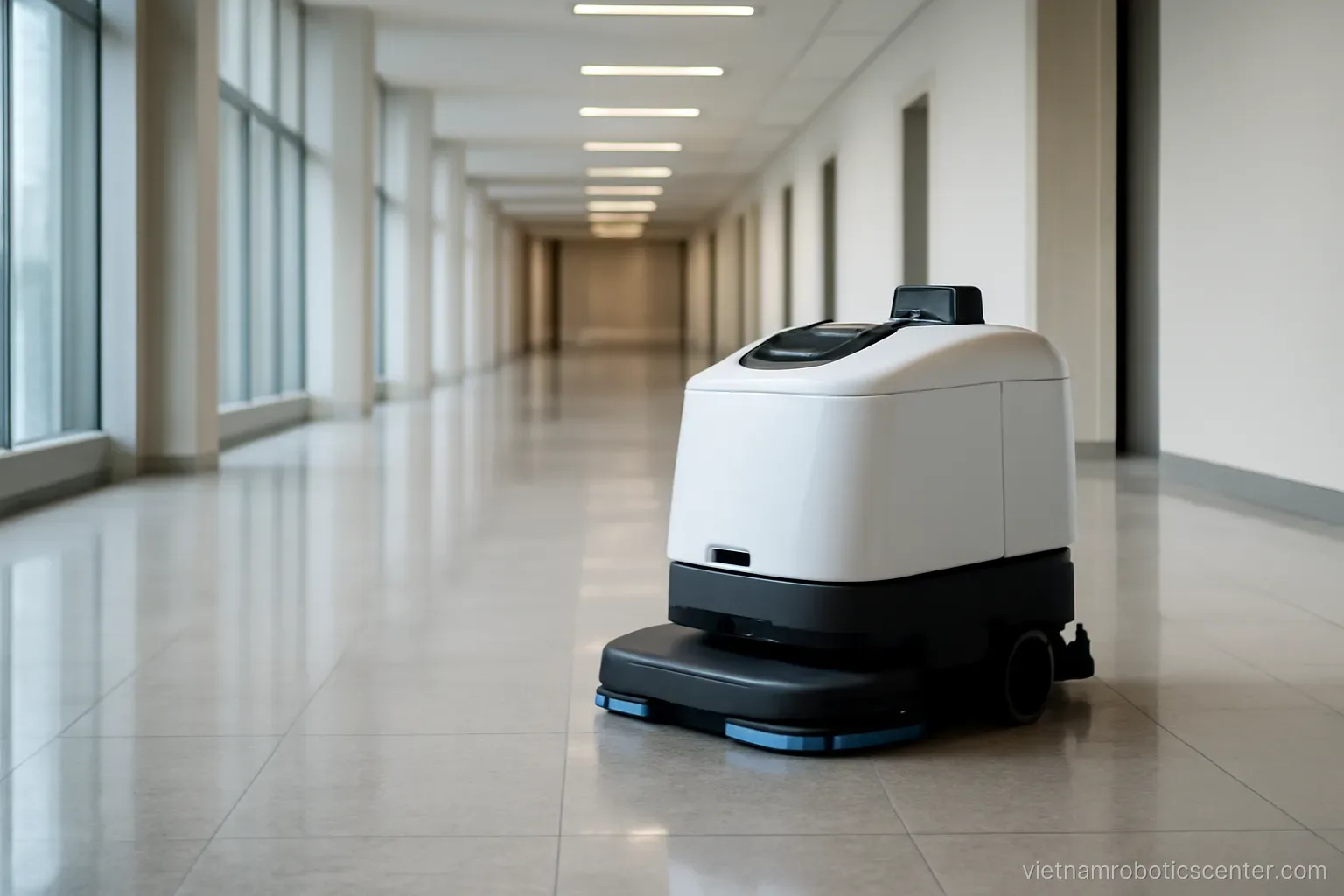
Floor cleaning robots do not appear in press coverage and nobody photographs them. They are also the service robot category with the clearest economics, because the work is purely repetitive, the area is measurable, and labour cost is directly comparable.
What cleaning robots do
Clean large floor areas. Vacuuming, wet scrubbing, polishing depending on the machine. This is the largest time component of building cleaning work.
Run on a schedule, including overnight. No attendant needed, and running at night means no interference from foot traffic.
Record the work. Area covered, duration, sections missed. For a contract cleaning provider this is valuable evidence for the client.
What they cannot do. Wipe furniture, clean glass, service washrooms, empty bins, remove stubborn marks, clean corners and under fixtures. These still need people and they represent a substantial share of the work.
So the correct framing is: the robot covers the open area, people cover the detail. No robot replaces a full cleaning shift, and any supplier claiming otherwise deserves careful questioning.
Where they fit
Strong fit. Large lobbies, long corridors, car parks, industrial halls, supermarkets, airports, hospitals. The common property is large open area with few obstacles and hard flooring.
Poor fit. Offices dense with desks, small rooms, areas with steps, thick carpet, spaces rearranged frequently.
The deciding factor is the share of open area. A five hundred square metre open lobby is almost entirely cleanable by robot; the same area filled with desks means the robot cleans only the walkways.
How to estimate. Look at the floor plan and estimate what percentage is continuous open space. Below a certain threshold, efficiency is insufficient.
Steps and level changes. Most cleaning robots cannot cross steps. A building with several floor levels needs multiple machines or someone to carry the machine between zones.
Calculating efficiency
This is the easiest robot category to cost, because the unit of measurement is unambiguous.
Measure current area and time. How many square metres one person cleans per hour, in which zone.
Measure real robot throughput. Not the catalogue figure. Real numbers are lower because of water filling, emptying, charging, and slower speeds in cluttered areas.
Account for what the robot cannot do. Detail work still needs people and those hours do not reduce.
Add operating costs. Water, chemicals, power, replacement brushes and pads, maintenance. This is not a small line.
Count time spent servicing the robot. Filling, emptying, moving it between zones, unjamming. This can reach a meaningful fraction of the machine's running time.
Compare cost per square metre. This figure compares directly against labour cost over the same area.
The usual result: robots are clearly advantageous on very large open areas and not advantageous on medium areas or cluttered ones. The exact threshold depends on local labour costs.
Daily operation
Cleaning robots need more attention than other service robots.
Filling and emptying water. Several times per shift depending on tank size. Convenient supply and drain points are needed, and they materially affect real throughput.
Cleaning the machine itself. Brushes, pads, filters, tanks. A dirty machine cleans poorly, and this is the leading cause of gradually declining quality.
Replacing consumables. Brushes and pads wear by area covered. A replacement schedule and stock are needed.
Clearing the route beforehand. Lifting chairs, removing obstacles. Otherwise the robot avoids them and leaves area uncleaned.
Checking the result. The robot reporting completion does not mean the floor is clean. Periodic human inspection is needed, especially at corners and difficult areas.
Assign responsibilities explicitly. Who fills, who cleans the machine, who inspects. Without assignment the machine degrades within weeks.
Common investment mistakes
Believing catalogue throughput. Measured on fully open area with no filling stops and no obstacles. Reality is usually considerably lower.
Expecting to eliminate cleaning staff. It does not happen. Detail work still needs people, and a calculation assuming a whole shift is removed will be wrong.
Ignoring operating costs. Consumables and maintenance together are a meaningful annual figure.
Not counting the time spent servicing the machine. If a person must follow it constantly, the benefit approaches zero.
Buying a machine too large for the space. Large machines have high throughput on open floor and cannot enter tight areas. A mid-size machine is often more effective overall.
Not trialling first. This is the equipment category where on-site trials are easiest — most suppliers will lend a machine for several days. Not taking that up means skipping the cheapest route to a real answer.
Frequently asked questions
Can a cleaning robot replace a whole shift?
No. It covers open floor area, while wiping furniture, cleaning glass, servicing washrooms, emptying bins and cleaning corners still require people — a substantial share of the total work.
What determines whether a cleaning robot is efficient?
The proportion of continuous open floor area. A large open lobby is almost entirely cleanable by robot; the same area filled with desks means only the walkways get cleaned.
Which costs are most often omitted?
Consumables and maintenance, plus the time people spend servicing the machine — filling, emptying, moving it between zones and unjamming. If someone must follow it constantly, the benefit approaches zero.
What is the cheapest way to verify before buying?
Borrow a machine for a few days and run it in your own building. Most suppliers will lend one, and this is the equipment category where an on-site trial gives the clearest answer.
More in Reception and event robots and Robots for real estate and showrooms.