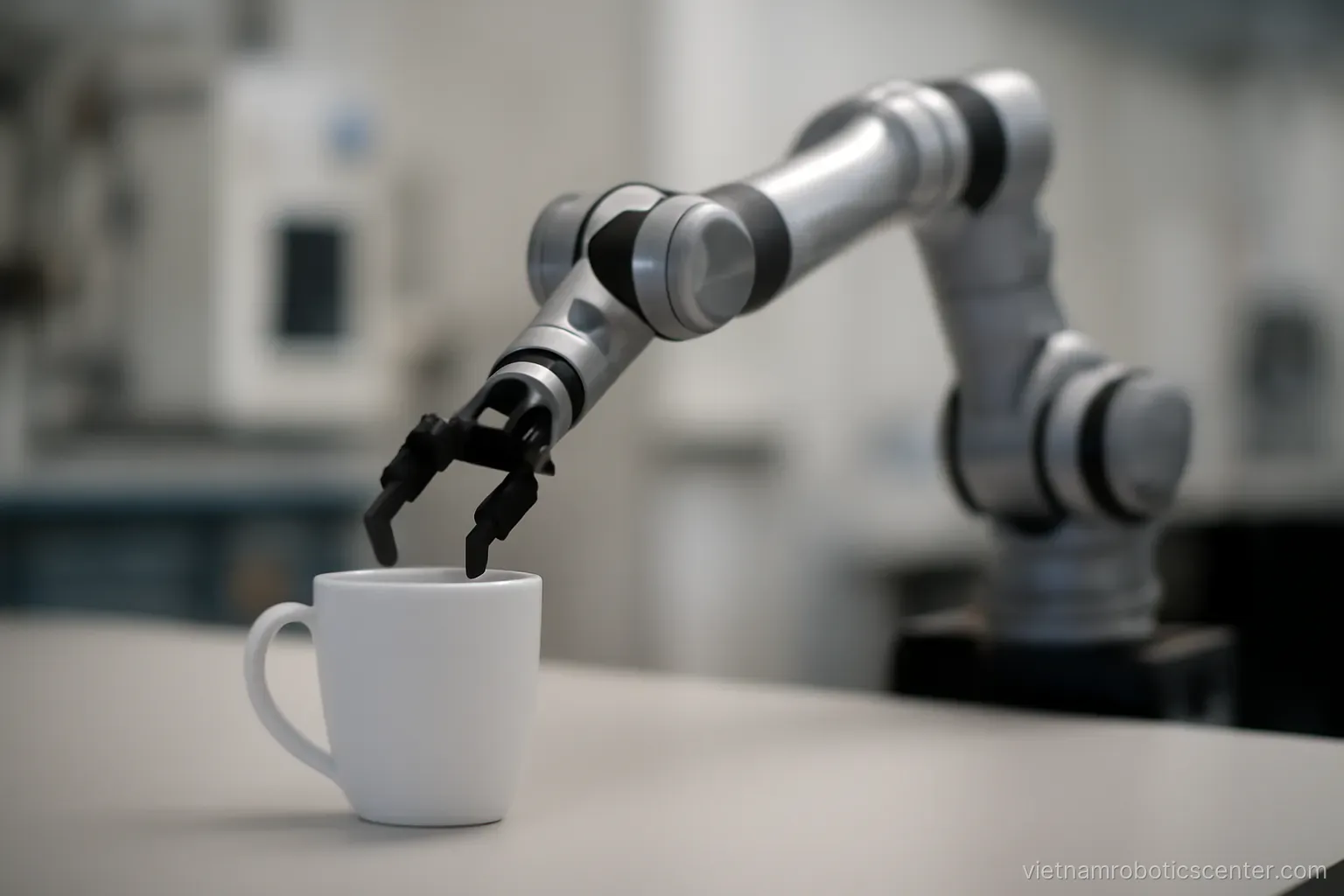
A modern AI model drafts contracts, writes code and solves problems. Put the same model inside a robot and ask it to tidy a table, and it struggles with something a small child manages. The gap has specific causes, and understanding them makes every robot sales pitch easier to evaluate.
Four fundamental differences
Consequences do not undo. A wrong sentence is edited. A dropped cup breaks. Robots must be right the first time in situations where software is allowed to retry.
Time does not wait. Two seconds late in a reply is mildly annoying. Two seconds late reacting to a falling object is too late. Physical action runs at a pace the world sets.
Data is orders of magnitude scarcer. Text exists online in enormous quantity. Data about how an arm actually grasped a cup has to be created, one attempt at a time, with real equipment.
Every body is different. Experience learned on one arm does not transfer cleanly to an arm of different size and strength, whereas one language model serves everyone.
These four together explain why progress on talking has outrun progress on doing, despite both using broadly similar techniques.
What a text-trained model lacks
A model trained on text knows a great deal about the world and nothing about what it weighs.
It has read millions of sentences about cups. It knows a cup holds liquid, that it breaks, that liquid spills when tilted. It has never held one, so it has no sense of how firmly to grip before it slips, or how far it tilts before the contents move.
That kind of knowledge — implicit physical understanding — humans acquire through years of touching everything, and it is almost never written down precisely because it is too obvious to anyone who has it.
The practical consequence: a robot can describe fluently what it is about to do and then do it wrong. Verbal fluency is not evidence of physical competence, and this is exactly where demonstrations mislead most easily.
How the gap is being closed
Four approaches, each with results and limits.
Training in simulation. Millions of attempts in software, fast and breaking nothing. The problem is that simulation diverges from reality precisely where things are difficult — friction, softness, deformation — so learned skills do not always transfer.
Teleoperation for data collection. A person operates, the robot records action and sensor data together. High quality, extremely slow and labour-intensive to gather.
Learning from video of people. Abundant data, but video records no forces, and a human body differs from a robot body.
Large models trained across many robot types. Training on data from diverse machines in the hope of learning what is common. This is the most-watched direction currently.
None has solved the problem. Progress is real and considerably slower than short videos suggest.
What works and what does not
The boundary is fairly clear if drawn by how much variation a task contains.
Working now. Repeated manipulation of known objects in known positions. Navigation in mapped spaces. Recognition and conversation. Pick-and-place of rigid, consistently shaped items.
At the boundary. Picking unfamiliar objects. Manipulation in cluttered spaces. Working alongside moving people.
Not yet reliable. Manipulating soft and deformable items — cloth, cable, food. Long multi-step sequences where each step depends on the previous result. Handling genuinely novel situations without human intervention.
Applied to evaluating a product: ask which group the specific task falls into. If it belongs to the third and the seller says it is ready, that is a signal to proceed carefully.
What this means for buyers
Design the task to reduce variation. The highest-leverage action and the least considered. Items placed in fixed positions, trays with compartments, clear aisles, stable lighting — each moves the robot's problem down a difficulty step.
Pick tasks where failure is harmless. Start where a mistake causes inconvenience rather than damage.
Always keep a path back to a human. The robot must stop safely and call for help when it hits something beyond its capability, rather than continuing.
Measure success rate, not impression. Record attempts and successes. The figure is usually well below the impression left by watching a few good runs.
Do not buy from video. A thirty-second clip may be the fiftieth attempt. Ask to see continuous operation, with your objects, in a space resembling yours.
Frequently asked questions
Why is AI good at answering but poor at acting?
Because physical consequences do not undo, time does not wait, action data is orders of magnitude scarcer than text, and experience does not transfer cleanly between robot bodies of different sizes and strengths.
Does fluent description mean the robot can do the task?
No. A text-trained model knows a great deal about the world without the implicit physical understanding — how firmly to grip before slipping, how far to tilt before spilling — that humans acquire through years of contact.
Which tasks remain unreliable?
Manipulating soft deformable items like cloth, cable and food; long multi-step sequences where each step depends on the last; and handling genuinely novel situations without a person available to intervene.
What can a buyer do to improve the odds?
Redesign the task to reduce variation — fixed item positions, compartmented trays, stable lighting — choose tasks where failure is harmless, and ensure the robot stops and calls a person when it exceeds its capability.
More in Robots for real estate and showrooms and Training and customising a robot.