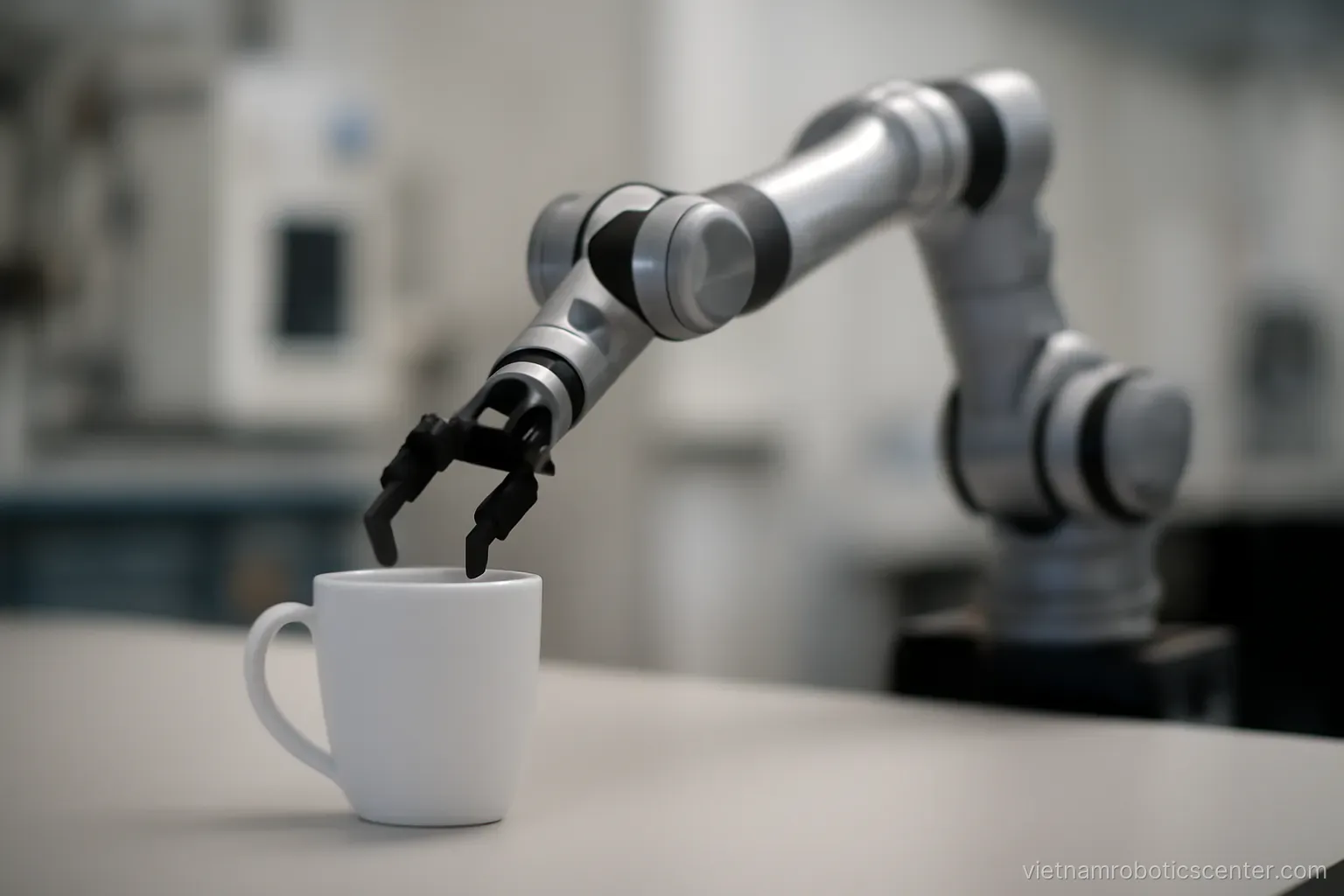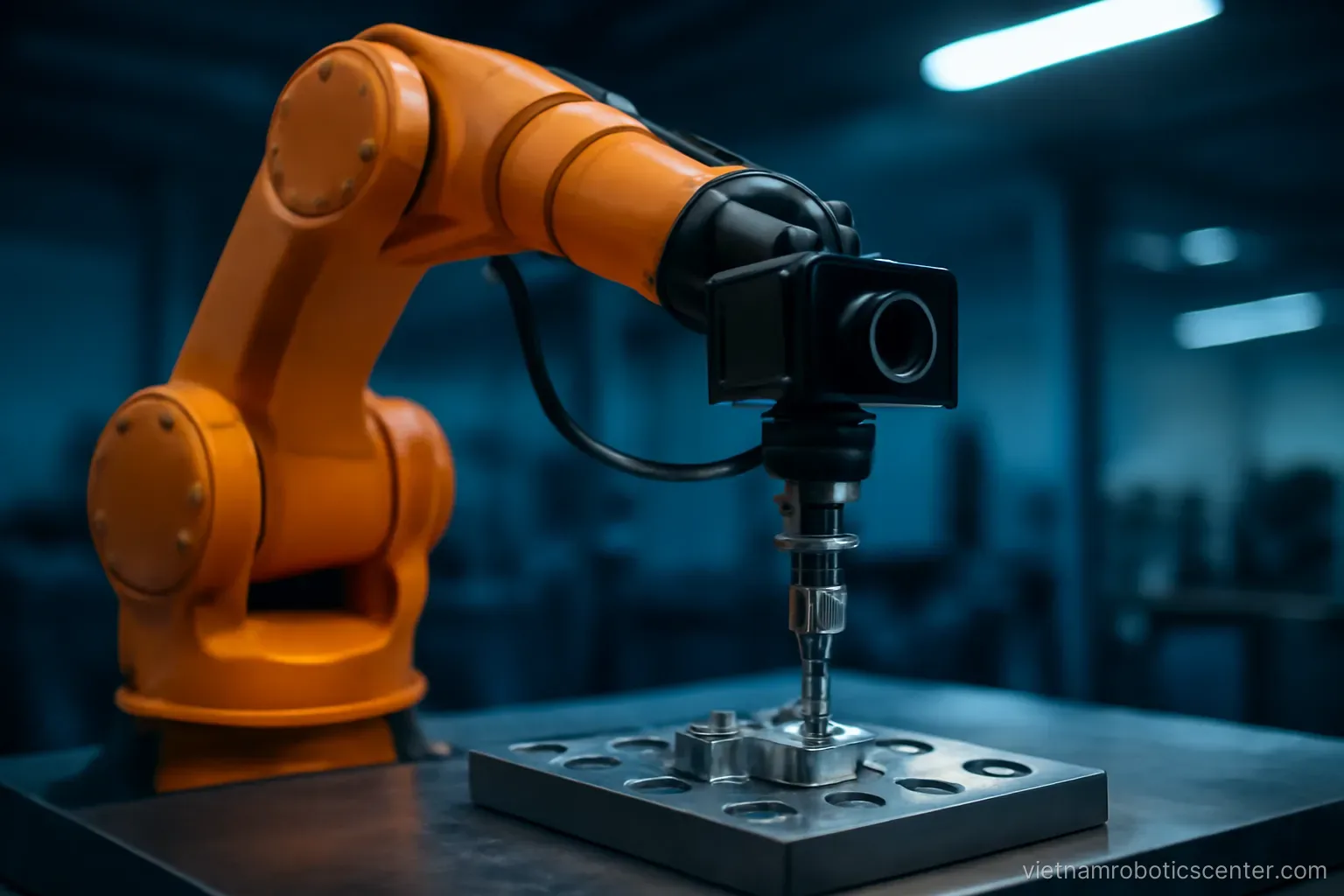
A traditional industrial robot arm learns through teach-and-repeat: an engineer moves it through motions, it records the path, it repeats exactly. A modern AI robot learns from data and variation: it observes, builds a model of the task, adapts when conditions change. This is not just a software difference—it changes what robots can do without constant human reprogramming. This article separates what changed fundamentally, what is reliably working in facilities today, and where the learning systems still need a person in the loop.
What teach-and-repeat robots could and could not do
Teach-and-repeat assumed a static environment. The workpiece arrived in the same position, the lighting was constant, the tool never wore unevenly. Any deviation broke the task or required manual intervention.
These robots were fast and precise on narrow tasks. A welding robot that repeated the same seam thousands of times, or a pick-and-place arm moving components between two fixed bins—these systems ran reliably for decades because the variation was engineered out of the process first.
Reprogramming meant stopping production. If the part design changed, if the workbench layout shifted, if tolerances tightened, the robot had to be taken offline and re-taught by a skilled technician. This cost time and money.
No real understanding of the task existed in the robot. The arm had coordinates and timing. It did not model what it was doing—why a part needed to be held at an angle, how to detect if it had already been processed, whether a surface was clean enough.
Quality control happened downstream. The robot executed; human inspectors checked the result. If something went wrong mid-task, the robot usually did not know and continued anyway.
Scaling to new tasks meant new hardware or new code. A robot that could assemble motors could not easily switch to assembling gearboxes. The motion paths, grip forces, and timing had to be completely re-engineered.
Sensor data was minimal and rigid. Older robots used simple binary switches: part present/absent, position reached/not reached. They did not interpret rich sensory information.
Human expertise was embedded in the program, not the machine. An experienced technician wrote the teach pendant commands. When that person left, knowledge often went with them.
Cost was front-loaded into setup. Once running, the robot was cheap per unit. But the initial programming and integration could take weeks.
Predictability was high, flexibility was low. You knew exactly what the robot would do. You did not know what it would do if something was slightly different.
What shifted when robots began learning from data
Robots now model the task, not just memorize paths. An AI robot can learn that a bolt-tightening task requires applying force until resistance rises, not applying force for exactly 2.3 seconds. This model transfers to similar bolts, different sizes, different materials.
Variation became something to learn from, not eliminate. If parts arrive at slightly different angles or positions, a robot with vision and learning can detect this and adjust its approach. The engineer no longer has to fixture everything into perfect alignment.
Sensor data became rich and interpretable. A robot with a camera and AI can detect if a surface is clean, if a component is oriented correctly, if a previous step succeeded. This information feeds back into the next decision.
Adaptation happens without stopping the line. A robot trained on bolt-fastening with M6 bolts can often handle M8 bolts with no human intervention, because it learned principles, not sequences. When it encounters something it cannot handle, it can flag it for a human rather than failing silently.
Learning reduced the time to deploy on a new task. Instead of weeks of teach-pendant programming, some tasks now take days of data collection and training. The robot learns from demonstration or from observing human workers, rather than requiring an expert programmer.
Quality control moved into the robot. Real-time feedback from sensors means the robot can detect problems mid-task: a part slipping, a tool wearing, a surface not meeting spec. It can compensate or stop and alert.
Knowledge became reusable across similar tasks. A vision model trained to detect part orientation on one assembly line can be adapted to another. The underlying learning transfers.
Humans and robots began sharing context. A robot could now ask for clarification—through a screen or interface—or explain why it stopped. This reduced guesswork about failures.
The cost structure inverted. Setup time dropped, but the cost of collecting and labeling training data rose. The payoff came from running many variants of a task, not from running one task at scale.
Predictability changed character. A learning robot is less predictable in its exact motions but more predictable in achieving the goal across variations. This requires a different way of thinking about safety and validation.
What is working in production facilities right now
Vision-guided pick-and-place is mature and deployed widely. A robot with a 2D or 3D camera can locate items in a bin or on a conveyor, even if they are jumbled or slightly rotated. The vision system runs a learned model; the robot adjusts its grip and approach accordingly. This is not a demo—it is standard in e-commerce, automotive, and food processing.
Defect detection by learned vision is reliable at scale. Robots (or stationary cameras feeding to robots) can classify parts as good or reject using trained image models. The accuracy is often as good as or better than human inspection, and it runs continuously without fatigue.
Adaptive force control for assembly tasks is in production. A robot fastening bolts, inserting connectors, or pressing components uses learned force-feedback to adjust pressure and timing. It stops when it senses the right resistance, not when a timer expires. This reduces cross-threading, component damage, and rework.
Trajectory adaptation for part-to-part variation is standard. A robot welding, grinding, or coating a part can adjust its tool path based on the actual position and shape of the workpiece, detected by camera or by probing. The base motion is learned from data; the adaptation happens on each cycle.
Collaborative robots with learned safety behaviors are deployed. Cobots using force and vision feedback can work alongside humans more safely than earlier designs, because they sense obstacles and apply learned stopping rules. This is not foolproof, but it is real and improving.
Predictive maintenance using learned sensor patterns is beginning to reduce downtime. Robots equipped with vibration, temperature, or acoustic sensors can learn normal operating patterns and flag anomalies before failure. This is still maturing but is in production use.
Bin picking with deep learning has moved from lab to factory. Systems combining 3D cameras and neural networks can extract and orient randomly placed objects at speed and accuracy that older teach-and-repeat pick systems could not match.
Quality feedback loops are tightening. Robots that learn from inspection data—their own or from downstream stations—can adjust parameters in real time to reduce scrap. This closes a loop that teach-and-repeat robots could not.
Human-in-the-loop labeling is now a standard production tool. Workers or engineers spend time labeling a small set of images or examples; the robot learns from this and asks for clarification on edge cases. This is slower than full automation but faster than manual programming and more reliable than unsupervised learning.
Multi-step tasks with decision points are running in production. A robot can learn to perform task A, assess the result, and choose between task B or task C based on what it observes. This conditional logic is learned, not pre-programmed, making it more adaptable.
Where learning robots still require heavy human guidance
Long-horizon planning with many decision points remains mostly in demos. A robot that must reason ten steps ahead, weigh trade-offs, and adjust strategy based on an evolving goal still requires substantial human oversight. Most deployed robots handle tasks spanning a few seconds to a few minutes, not complex workflows over hours.
Generalizing to truly novel tasks without retraining is not yet solved. A robot trained on assembling one type of connector struggles with a fundamentally different connector without new training data. Transfer learning helps, but it is not magic—you still need examples of the new task.
Operating in unstructured outdoor or variable environments is still mostly research. Robots picking fruit, inspecting infrastructure, or working in construction sites perform better with AI vision than earlier systems, but they still fail on edge cases and require human intervention or re-tuning regularly.
Safety certification for learning-based systems is incomplete. Regulators and manufacturers still struggle to validate and certify robots whose behavior emerges from learned models rather than explicit rules. A robot must be proven safe, but learned behaviors are harder to prove exhaustively.
Explaining why a learned robot failed is still a research problem. When a vision model misclassifies a part or a learned policy makes an unexpected choice, the robot often cannot explain why. This slows debugging and makes humans reluctant to trust the system fully.
Continuous learning on the job without human review risks propagating errors. A robot that learns from its own mistakes in production can improve—or it can learn bad habits if not monitored. Most deployed systems learn only from human-validated data or in controlled retraining windows.
Handling rare or adversarial cases still requires human intervention. A robot trained on thousands of normal parts will fail on the one unusual item. Detecting this and routing it to a human is solved; automating the handling of the unusual case is not.
Multi-robot coordination and task negotiation is still in pilot stage. Two robots learning to work together, sharing tools, or deciding who does which task is not yet a standard production pattern. Most multi-robot setups still use explicit coordination rules.
Adapting to wear, drift, and seasonal change is semi-automated at best. A robot's camera can drift out of calibration, its gripper can wear, environmental lighting can change seasonally. Learning systems can detect some of this, but retraining and recalibration still usually require human judgment.
Real-time learning during production is still limited and risky. Most deployed robots learn during offline training or in controlled retraining phases. Learning live on the factory floor, while running, risks quality and safety—so it remains rare.
How to evaluate what a learning robot can do for your facility
Ask whether the task has sufficient variation to justify learning. If your parts always arrive in the same position and quality, a traditional teach-and-repeat robot may still be the simpler choice. Learning-based systems shine when variation is high but the underlying task is consistent.
Assess the cost of re-programming versus the cost of collecting training data. If you change product variants frequently, learning can reduce re-programming time. If you change rarely, the overhead of data collection and labeling may not pay off.
Evaluate whether you have labeled data or can generate it. Learning systems need examples. If your facility already logs images or sensor data, retraining is faster. If you must start from scratch, budget time and labor for data collection.
Check whether the task is well-suited to perception or primarily requires reasoning. AI robots excel when the challenge is interpreting sensory data—is this part oriented correctly? Is the surface clean? They struggle when the challenge is abstract planning—should we do this task first or that one?
Verify that the vendor or integrator can support your specific variation range. Ask for examples of tasks similar to yours, not just impressive demos. What variations did they encounter? How many retraining cycles did it take? What went wrong?
Understand the validation and safety certification status. For regulated industries, confirm that the learning system can be certified. Some vendors have clear certification paths; others are still working on them. This affects deployment timelines.
Plan for the human effort to oversee learning. Even when a robot learns automatically, someone must monitor quality, label edge cases, and retrain periodically. Budget this labor, do not assume it is zero.
Test on a small batch before committing to full production. Run the learning robot on a subset of your parts for a week or month. Measure scrap, downtime, and the time humans spend intervening. This gives you real data, not vendor claims.
Consider the long-term cost of model drift. As your parts evolve, your materials change, or your environment shifts, the learned model may degrade. Plan for periodic retraining and validation. This is an ongoing cost, not a one-time investment.
Weigh the flexibility gain against the loss of full predictability. You gain the ability to handle variation without reprogramming. You lose the guarantee that the robot will do exactly the same thing every time. Decide if this trade-off fits your quality and safety requirements.
Frequently asked questions
Is a learning robot just a traditional robot with a camera?
No. A traditional robot with a camera is still executing pre-programmed motions; the camera only helps position it correctly. A learning robot builds and updates a model of the task from data. It adjusts its strategy based on what it observes, not just where it is. This requires different software, different training methods, and different ways of thinking about safety and validation.
Can a learning robot work without any human help after training?
Most deployed learning robots require some human oversight. A human reviews edge cases, labels data for retraining, and intervenes when the robot encounters something outside its training distribution. Full autonomy without human-in-the-loop is still rare in production. The benefit of learning is that you need fewer humans than with traditional reprogramming, not that you need zero humans.
How long does it take to train a robot for a new task?
It depends on task complexity and data availability. A simple pick-and-place variant with good labeled data can take days to a week. A complex task with poor initial data or many edge cases can take weeks or months. This is often faster than traditional teach-and-repeat programming, but not instantaneous. The time is spent collecting and labeling data, not writing code, so it feels different but is not free.
What happens if a learning robot encounters something it was not trained on?
It usually fails—it makes an incorrect choice or stops. A well-designed system will flag this and route the item to a human, rather than making a silent error. Some systems can ask for clarification or request a label for the new case. Over time, if you collect enough examples of these edge cases and retrain, the robot improves. But there is no magic—if something is truly novel, the robot must learn it, just like a human would.
More in Service robots in hospitality and retail and Training and customising a robot.